Tuesday, February 28, 2017

Small Engine Equipment Storage - Early Spring

About the same time as I noticed we couldn't find a couple of backpack blowers when they came due for their 30-day service, we got a call from a detective who was working on the Pawn Shop detail...

Long story short; we have one fewer employee and have implemented a new way to store and keep track of our blowers and trimmers.


I thought for a while about the need to control inventory and also make it quick and easy to monitor. This chain link cage measures 7' X 20', and occupies a convenient location between our two inside facing bay doors; the wall separates the workshop from reel mower storage areas.


Each equipment item has a designated spot, and a daily check takes seconds.


I decided on 16" spacing for the vertical discharge tube hooks. The new storage location makes it very convenient for employees who are gearing up for mowing greens, as we have the mowers, blowers, mixed fuel storage, etc., all in the same area.

Our new procedure is working out well. Managers assign needed equipment, which the employees remove from the cage when needed. Employees then return the equipment to the maintenance shop after use, where a technician checks it over before returning the item to the correct location in the cage. At the end of the day, whoever is locking up that day can see quickly if something is missing.

Sprung Spring...


With the exceptionally mild Winter and early Spring we are experiencing in Atlanta, the greens have a lot of tender new growth which will need to be covered whenever frost is possible. Above is a view of 6 Green on the Highlands course getting a good heavy dusting - almost a month earlier than usual for the first topdressing of Spring. It's a good thing that all of our mowers are serviced and ready for action - and our reel grinder is always ready for a workout, which it will get soon!

Regards,

Wednesday, February 15, 2017

February 2017 Shop Photos


Here's "my" corner of the shop with the new mill and lathe, and my toolbox. We painted the walls bright white semi-gloss and installed the Armorpoxy Supratile floor tiles. Still waiting for the electrician to hook up the new machines, but I did get the mill trammed in.


I have a list of jobs ready for each of these. The mill is going to see plenty of bedknife shoes and other bits, and the lathe is going to spin all my rollers true.


The 3500 square feet of floor tiles took five of us a weekend to install. Cost was $15,000 - $5000 less than my best epoxy quote. The building is 53 years old and there was no vapor barrier used when the floor was poured. All of my epoxy quotes included an additional sealer step to ensure adhesion. The only prep needed for tile installation was a good sweeping.


Safety Center with new Eyewash Station.


New Lista benches are great for shop tool and supply storage. The left bench will have all of our two-stroke parts, supplies, and specialty tools. Doors were painted John Deere green, and the green and yellow theme fits this shop well.

Regards,

Tuesday, February 14, 2017

What; a year? (What a Year!)

Yes, yes - I know - I've been busy. In the year that I've been away, I've...

  • Changed out reel mower and utility vehicle fleets
  • Changed out the reel and bedknife grinders for SIP machines
  • Implemented new cutting unit maintenance standards and procedures
  • Updated waste oil handling equipment and procedures
  • Replaced portible fuel cans and storage cabinets
  • Authored and implemented our new GCM employee training program
  • Went through a major renovation of the Highlands course
  • Set up a shop safety center with lock out / tag out and emergency eyewash station
  • Purged over 50% of old parts inventory and negotiated penalty free credit from distributor
  • Purchased a Mazdaspeed Miata, sold the TR6, started playing with the Miata
  • Renovated the maintenance shop with new paint, flooring, and benches
  • Updated shop tools and tool storage cabinets 
  • Installed a vertical mill and lathe in the shop
  • Hosted the GGCSA annual Equipment Managers Seminar
  • Implemented new 2-stroke equipment storage and handling procedures
  • Spent quite a few hours on conference calls with the test writing team at GCSAA 
  • Went to yet another Golf Industry Show in Orlando
 ... along with the standard equipment repairs and maintenance. I'll post some follow-ups to expand on the above soon.

Regards,

Friday, February 19, 2016

Procedures...

One thing I've found to be vital for success in the shop is establishing standards and defining the most critical procedures to ensure critical operations are done the same way by everyone, all the time.  Below is what I consider our most important procedural document at AAC; "Turf Cutting Unit Maintenance Policy and Procedures":


The purpose of this document is to establish guidelines for proper reel-type cutting unit maintenance.

Policy and Procedure:
All technicians involved in the maintenance of reel-type cutting units used to mow turf at the Atlanta Athletic Club will follow the procedures outlined below in order to provide consistently high quality turf mowing and after cut appearance. Any deviation from the guidelines outlined below must be approved by the Equipment Director or Director of Agronomy. Proper personal protective equipment for cutting unit maintenance includes safety glasses. Tools used for cutting unit maintenance include a Pi Tape, micrometer, calipers, surface plate, cut test strips, and feeler gauges. Ability to read a Vernier scale is necessary to use a Pi Tape and micrometer correctly.

1.      General Guidelines:
a.       The terms “left” and “right” reference positions or directions relative to the machine operator’s orientation while operating the machine.
b.      The “leading” end of a reel references the end of the reel whose blade ends first cross the bedknife during operation.
c.       The “trailing” end of the reel is opposite the leading end.
d.      All cutting unit sets for triplex mowers and fairway mowers will be maintained in sets, and cutting unit sets will be labeled with the set number.
e.       Cutting unit position on the mower will be referenced as follows:
                                                              i.      The center cutting unit is #1.
                                                            ii.      The cutting units on the left side of the machine are even-numbered, from the center out.
                                                          iii.      The cutting units on the right side of the machine are odd-numbered, from the center out.
f.       Reels will be changed and recycled when they reach the following minimum diameters:
                                                              i.      4.650” for 5” reels.
                                                            ii.      6.650” for 7” reels.
g.      Reels for tournament-prepared greens cutting units will be inspected by the Equipment Director prior to the event and any special setup will be determined at that time.
h.      Bedknives will be changed and recycled when the top face reaches the valley floor of the top relief area, or as instructed by the Equipment Director.
i.        Greens mower bedknife front face thickness will be maintained at a maximum thickness approximately equal to half of the height of cut (HOC).
j.        Greens mower bedknife front face thickness will be maintained with less than 10% variance from leading to trailing ends. For example; if HOC is to be set at .100”, the bedknife will be ground to a .050” front face thickness, with no more than .005” difference between the leading and trailing end measurements.

2.      Post-Use Inspection and Adjustment: All reel-type cutting units will be inspected as soon as practical after each use for proper cut quality and HOC. This post-use inspection will include the following items, in order:
a.       Visually inspect cutting units for excessive debris or chaff buildup on reel blades, rollers, etc. Report excessive debris due to insufficient cleaning to a Course Supervisor or the Equipment Director.
b.      If reel blades have excessive buildup; pressure wash the reel blades, making sure to avoid spraying high pressure water near grease seals.
c.       If cutting units have little debris, proceed with blowing out the cutting unit with compressed air and inspecting the reel blades and bedknife for damage. If damage is found, coordinate cutting unit repair or replacement with the Equipment Director.
d.      Inspect all roller bearings for free play and rough rolling resistance. If there is any question that a roller bearing is serviceable, report it to the Equipment Director and coordinate replacement. Lube roller bearings if applicable and wipe any excessive grease from the unit with a shop towel.
e.       Inspect all reel bearings for free play and rough rolling resistance. If there is any question that a roller bearing is serviceable, report it to the Equipment Director and coordinate replacement. Lube reel bearings if applicable and wipe any excessive grease from the unit with a shop towel.
f.       Inspect cut quality following these steps:
                                                              i.      Insert a Toro test strip (part # 125-5610) perpendicular to the bedknife so that the test strip is between a reel blade and the leading edge of the bedknife.
                                                            ii.      Turn the reel forward to cut a ¼” piece of the test strip at each of five places along the bedknife; once near each end, once at the center, and once between the center and each end. The reel should cut the test strip cleanly with minimal effort at each location along the bedknife. Hold the test strip up to the light and check for a “fuzzy” cut.
g.      If cut quality is less than optimal, proceed by adjusting the reel to bedknife clearance following these guidelines:
                                                              i.      For John Deere QA5 cutting units; maintain a .001” minimum gap using a feeler gauge. Adjust the bedknife to the reel until correct clearance is achieved.
                                                            ii.      For John Deere QA7 cutting units; maintain a .002” minimum gap using a feeler gauge. Adjust the reel to the bedknife until there is contact, and then adjust the reel away from the bedknife until proper clearance is achieved.
                                                          iii.      For Toro cutting units; maintain a minimal amount of contact between reel and bedknife. Adjust the bedknife to the reel until correct clearance is achieved.
h.      If cut quality cannot be restored without excessive reel to bedknife contact, coordinate cutting unit sharpening with the Equipment Director.
i.        Check/adjust HOC as outlined in Section 6, Cutting Unit Assembly.

3.      Spin Grinding Reels:
a.       Each technician who will be grinding reels must first be instructed about, and fully understand, the grinder Machine Operation Manual.
b.      All reels to be ground will first be measured with a Pi Tape, and the leading/trailing diameters recorded on a grinding worksheet.
c.       Cutting units will be maintained in sets; if one reel needs to be ground, all reels in the set will be ground to maintain the following specifications:
                                                              i.      Each reel in the set will be maintained within .020” diameter of each other.
                                                            ii.      Each reel will measure within .005” on the leading and trailing diameter.
d.      Inspect all bearings and seals prior to mounting the cutting unit on the grinder.
e.       Each cutting unit will be checked for parallelism as part of the grinding setup.
f.       Each reel will be ground the minimum amount necessary to remove rounded edges from the reel blades
g.      The reel grinder will be cleaned with a vacuum at the end of each day the machine is used. Do not blow debris off the grinder. Track shafts and bearings will be wiped down with a dry shop towel. Do not use any lubricants or chemicals on the grinder.

4.      Relief Grinding Reels:
a.       All 5” reels will be relief ground at an approximate 30 degree angle, have a finished land width of between 10% - 15% of the blade thickness, and minimal variation between leading and trailing ends of the reel blades. Minimum diameter for relief grinding 5” reels is 4.700”.
b.      All 7” reels will be relief ground at an approximate 30 degree angle, have a finished land width of between 15% - 20% of the blade thickness, and minimal variation between leading and trailing ends of the reel blades. Minimum diameter for relief grinding 7” reels is 6.700”.
c.       The reel grinder will be cleaned with a vacuum at the end of each day the machine is used. Do not blow debris off the grinder. Track shafts and bearings will be wiped down with a dry shop towel. Do not use any lubricants or chemicals on the grinder.

5.      Grinding Bedknives:
a.       Each technician who will be grinding bedknives must first be instructed about, and fully understand, the grinder Machine Operation Manual.
b.      Visually inspect each knife to be ground for cracks or other damage. Clean knives as necessary to ensure an accurate grind and long grinding wheel life.
c.       Ensure knife grinder is set to grind the proper angles for the application prior to mounting the knife in the machine.
d.      Ensure coolant level is adequate prior to grinding.
e.       The bedknife grinder will be cleaned with a vacuum at the end of each day the machine is used. Do not blow debris off the grinder. Track shafts and bearings will be wiped down with a dry shop towel. Do not use any lubricants or chemicals on the grinder.

6.      Cutting Unit Assembly:
a.       Impact wrenches are not permitted for cutting unit assembly. Power ratchets are permitted if output torque is limited to 25 lb. ft.
b.      All bedknife screws will be tightened to 12 lb. ft. torque, in an alternating pattern from the center out, using the supplied torque wrench.
c.       All cutting unit assembly and configuration will be performed according to manufacturer’s instructions; cutting unit modifications are not permitted unless specifically authorized by the Equipment Director.
d.      HOC tolerance is +/- .001” for 5” cutting units, and +/- .003” for 7” cutting units. Report any excessive roller runout to the Equipment Director.
e.       When setting HOC, cutting units will be adjusted at least .010” low, and then HOC gradually increased to the desired setting, moving the adjusters to within .003” of target HOC, and then checking alternate sides and making any fine adjustments before moving to final HOC. HOC will not be adjusted down from an excessive HOC; if the desired HOC setting is missed, the process is repeated from the beginning.

Employee signature below constitutes employee's understanding of the Cutting Unit Maintenance Policy and Procedure.
Employee Signature    __________________________________                Date_____________
Printed Name              ___________________________________

If you were reading through the document and thinking that it seems excessive, you need to understand that cutting units are the life blood of the operation, and I've been able to achieve a certain amount of success by focusing a majority of my energy on quality of cut and after cut appearance. There is very little "extra" work involved in maintaining a higher standard once it is achieved. 
I know we will have our hands full going through all of our new cutting units when they come in this spring (factory tolerances aren't all they're cracked up to be) but once they are dialed in we can be tournament ready on short notice.
Regards,

Saturday, January 9, 2016

Happy New Year 2016

Moving into the new year, we have committed to several lines of improvement at the Atlanta Athletic Club and I am excited to get through the winter and get things moving!

We have re-written our Technician Job Descriptions at the AAC to include (among other things) the requirement of completing the GCSAA Certificate Program for equipment technicians (originally developed by the IGCEMA and adopted by the GCSAA) within one year of signing. This requirement is designed to compel personal and professional growth, and to ensure our technicians have the knowledge base needed to be effective on the shop floor. AAC is providing all the study guides and testing costs, and also providing 1-1/2 hours of paid study time each week (an extra 1/2 hour lunch three days each week). Any technician not completing all six certificates within one year will no longer meet the employment requirements of AAC and will need to resign. We already had one technician resign who said his level of dedication to this industry didn't justify the effort; he's going back into the construction industry where he started and I wish him well.

I encourage every technician to complete the program in order to prove your technical ability and to show your dedication to professional development. You might even learn a thing or two, which is never bad. I have so far completed Engines, Drivelines, and Hydraulics, and I am set to take the Sprayers test next week. After that I will need to take the Cutting Units and Electrical tests and I will be done.

I have begun the process of developing the AAC operator training program, and have a good outline of the program and  the boiler plate operation instructions for all equipment types finished. We will begin reviewing the plan in our weekly management meetings, I will add items or make changes as needed, and then we will be rolling out the plan in March of this year.

I have also begun the process of  organizing the parts inventory and small engine equipment storage areas, and indexing parts in the inventory file. We will begin receiving our new turf equipment in March, so I want to have as much of this groundwork done ahead of time.

I have found that having two or three projects going at the same time suits me, as I can bounce between the projects as I get tired and it keeps my perspective fresh.


This is my new official photo for the AAC directory. I will be at the Golf Industry Show in San Diego February 9-12, so if you see me please say hello - I'm always up for conversation!

Regards,


Tuesday, October 20, 2015

Environmental Concerns, and a Sweet SS

One of the first things to catch my eye when walking around the facility the first time was the waste oil tank sitting on the ground, with the used filter drum and empty oil drums stacked up...


The pipe going into the wall led to a basin where oil pans could be emptied - high tech, no?
The tank had been there so long the asphalt was laid around it, and the dents are from equipment running into it on more than one occasion. It was a single-walled tank and I'm so glad to see it gone.


Better, yes? A double-walled, 185 gallon tank, purpose-built for waste oil under the existing overhang to help keep the rain off and out of traffic. We will add a couple of bollards to help protect it and define the space.

Next up is patching the asphalt where the old repair was never finished, and getting the hanging BX cable rerouted in the existing conduit - we have several projects like this for the winter months ahead.

While I was out shopping for winter clothes this past weekend (I was in South Florida for 22 years) I spotted a sweet ride to share:


I took a closer look:


Absolutely done right, with a 600+ HP 572 big block, Wilwood brakes all around, subframe connectors (yes, I was on my hands and knees in the parking lot) I just walked slowly around the car while my wife shopped, hoping I wouldn't get drool on my chin...

Regards,


Tuesday, September 29, 2015

Demo Update

Not your Father's lawn mower...


We've come a long way from the days of black smoke rolling out the exhaust pipe of our diesel powered equipment. We will soon be taking delivery of a new John Deere mower fleet, but have taken Jerry Pate Turf up on their offer to provide us with current-spec mowers to evaluate. The machine above is a 4500-D rough mower with the new USEPA Tier IV compliant power unit from Yanmar. The 4500, and its big brother 4700, have been the class of the field for a few years now, and for the most part the basic machine has not changed outside of the requirements of the new powerplant.

The Tier IV requirements are so strict that the new engines need to employ several components to acieve compliance. Combustion chamber conditioning is accomplished with high pressure common rail fuel injection, turbocharging, and cooled exhaust gas recirculation. Exhaust after treatment consists of a catalytic converter and particulate filter. Engine management is by Bosch, and interfaces with other contol units on board via CAN bus.

All the manufacturers have approached the packaging the same way with the exhaust aftertreatment above the engine, close-coupled to the turbo outlet. Toro and Deere are using Yanmar, while Jacobsen went with the Kubota option.

Pros: Plenty-O-Power from the Yanmar, Hydraulically driven cooling fan can reverse direction to blow chaff off of radiator screen, typical 4500 productivity.

Cons: Control interface is a bit clunky compared to the Deere unit's auto-throttle, same deck/roller issues, my favorite planetary drives...


A grinder from Bernhard that can spin and relief grind.


Those who remember the old single-blade Foley units will see more than a couple of similarities. While I was eventually able to grind 13 QA5 reels (with outstanding finished product) the machine simply takes far too long to set up and run compared to the competition.


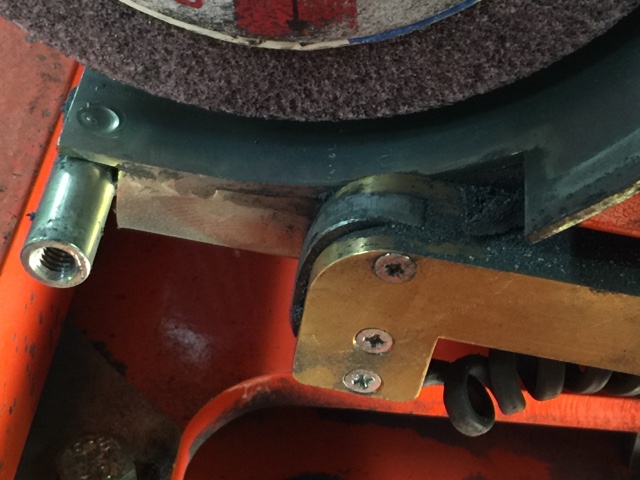
The indexing mechanism is driven by this 15mm stroke linear actuator. The blade guide/side cover has been removed here. The blade guide pivots on the same axis as the wheel, and when the actuator cycles the blade guide is allowed to drop out from under the blade.


Indexing completion is registered by applying blade pressure through the guide finger mechanism to this cam, which became fouled with grinding swarf after seven reels, necessitating the disassembly of the mechanism for cleaning.


This is the reduction gearbox and adjustable slip clutch which drives the reel for relief grinding. I am familiar with this type of slip clutch, which has been used by SIP for some time now...


Not a demo - we get to keep this stuff - our Eaton hydraulic supplies arrived from Lawson. We are setting up a crimper and fitting inventory to start making our own hoses. Progress...

Regards,